


Buy Canadian 100 Dollar Bill Online
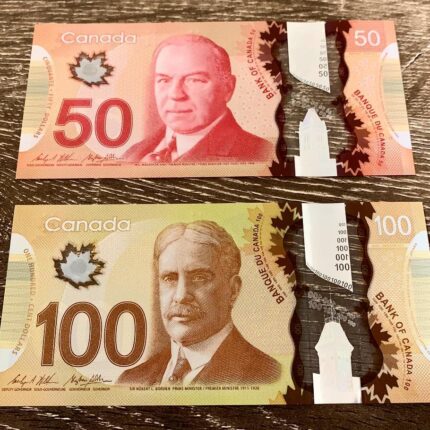
Canadian 100 dollar bill is a denomination of Canadian currency issued by the Bank of Canada. Like other Canadian banknotes, it is part of the polymer series introduced to enhance durability and security. The bill is red in color and features advanced security features to combat counterfeiting.
Canadian 100 dollar bill (symbol: $; code: CAD) is the official currency of Canada. It is abbreviated as C$ or sometimes referred to as the “loonie,” particularly when talking about the one-dollar coin, which features an image of a common loon, a bird native to Canada. The Canadian dollar is one of the world’s most traded currencies and plays a significant role in the global economy, especially in commodity markets.
Key Facts about the Canadian Dollar:
1. Currency Code and Symbol:
- ISO Code: CAD
- Symbol: $, or C$ to distinguish it from other dollar-denominated currencies like the U.S. dollar.
- Subunit: The Canadian dollar is divided into 100 cents.
2. Banknotes and Coins:
- Banknotes: The Bank of Canada issues five denominations of banknotes:
- $5, $10, $20, $50, and $100.
- Coins: Coins are issued in six denominations:
- 1 cent (penny) – no longer in production, but still in circulation.
- 5 cents (nickel).
- 10 cents (dime).
- 25 cents (quarter).
- 1 dollar (loonie) – featuring the common loon.
- 2 dollars (toonie) – a bi-metallic coin featuring a polar bear.
3. History of the Canadian Dollar:
- The Canadian dollar was officially introduced in 1858, replacing the Canadian pound. It was based on the decimal system, similar to the U.S. dollar, which simplified trade between the two countries. Canadian 100 dollar bill
- Canada adopted its own central bank, the Bank of Canada, in 1935, which took over the responsibility for issuing and managing the currency.
- The Canadian dollar was pegged to gold and later to the U.S. dollar until 1970, after which it became a floating currency, meaning its value is determined by supply and demand in global currency markets.
4. The Loonie and Toonie:
- The one-dollar coin, commonly known as the loonie, was introduced in 1987 to replace the paper dollar bill. It gets its name from the loon bird featured on the reverse of the coin.
- The two-dollar coin, or toonie, was introduced in 1996, featuring a polar bear on one side and Queen Elizabeth II on the other. It is a bi-metallic coin with an inner core made of aluminum-bronze and an outer ring of nickel.
5. Polymer Banknotes:
- Canada switched to polymer banknotes in 2011. These notes are made from plastic-like material that is more durable, harder to counterfeit, and more environmentally friendly compared to traditional paper notes. The polymer series features advanced security elements such as transparent windows, holograms, and raised ink. Canadian 100 dollar bill
6. Value and Exchange Rate:
- The Canadian dollar is considered a commodity currency, meaning its value often fluctuates with the prices of key Canadian exports, particularly oil, natural gas, and other raw materials.
- The exchange rate of the Canadian dollar varies depending on global economic factors. It is most commonly compared to the U.S. dollar (USD), and its value often moves in relation to fluctuations in the U.S. economy and commodity markets.
- In international financial markets, the CAD/USD exchange rate is closely monitored.
7. Role in the Global Economy:
- The Canadian dollar is one of the world’s most traded currencies, ranking among the top ten in global forex markets.
- It is often used as a reserve currency by central banks due to Canada’s stable economy and vast natural resources.
- Canada’s economic ties to the U.S., its role in the global oil and natural resources market, and its participation in trade agreements like NAFTA/USMCA contribute to the importance of the Canadian dollar on the world stage.
8. Factors Influencing the Value of the Canadian Dollar:
Several key factors affect the strength and value of the Canadian dollar in the foreign exchange market, including:
- Commodity Prices: Canada is a major exporter of oil, natural gas, timber, and minerals, so fluctuations in global commodity prices can affect the CAD’s value.
- Interest Rates: The Bank of Canada sets interest rates, and changes in these rates can attract or deter investment in Canadian assets, influencing the value of the CAD.
- Trade Relations: The Canadian economy is heavily integrated with the U.S. economy. Trade agreements, tariffs, or other trade-related issues can significantly impact the currency.
- Global Economic Conditions: Events like economic crises, geopolitical instability, or global recessions can lead to fluctuations in the CAD’s value as investors move their assets into or out of Canadian financial markets. Canadian 100 dollar bill
9. Central Bank and Monetary Policy:
- The Bank of Canada (BoC) is the country’s central bank, responsible for managing monetary policy, including setting interest rates, controlling inflation, and ensuring financial stability.
- The Bank of Canada uses inflation targeting to keep inflation in check, aiming for an inflation rate of around 2%. This helps stabilize the economy and maintain confidence in the Canadian dollar.
10. Inflation and Purchasing Power:
- Like most currencies, the purchasing power of the Canadian dollar changes over time due to inflation. The Consumer Price Index (CPI) is used to measure inflation in Canada, and the Bank of Canada adjusts monetary policies accordingly.
- Over the decades, inflation has caused the value of the Canadian dollar to decrease slightly, but Canada’s strong economy and sound fiscal policies have helped maintain overall confidence in the currency. Canadian 100 dollar bill
Buy Canadian 100 dollar bills to bid farewell to tough times
Canada is one of the leading destinations for immigration. Thanks to a stable economy and CAD’s low volatility range, this country ranks top among the best countries for a living. However, these facts don’t deprive Canadians and country visitors of force majeure circumstances when they need extra cash. Once you are going through hard times in Canada, you will need Canadian $100 bills.
Buy Canadian 100 Dollar Bill
Premier Bills is a trusted company on guard of your financial stability. Whatever life situations you undergo, you can always count on our support, buying 100% undetectable counterfeit 100 Canadian bills online with worldwide delivery. Order your bunch of fake CAD bills and say bye to tough times once and for all.
Premier Bills offers 100 dollar bills for Canada residents and foreigners
If it’s your first time buying counterfeit CAD notes, you may be worried about their quality. With us, you may drop your fears of being busted with a bunch of fakes, as we are experts in money production. The Canadian 100 dollar bill is one of the most complex banknotes, and Premier Bills is aware of that. Our camouflage notes are genuine-looking and boast the following features:
-
hologram stripe with the state emblem
-
watermark repeating the portrait depicted on the obverse
-
diving holographic metalized security thread
-
relief printing
-
colored protective fibers
-
UV luminescent ink
-
optically variable element Latitude
Moreover, we manufacture our fake Canadian 100 dollar bill using state-approved paper and ink, adhering to the government standards. We test each batch for flaws, providing our customers with ATM-friendly CAD bills of grade-A quality. Canadian 100 dollar bill
If you worry about your data safety and anonymity, we’ve taken care of that as well. Our website boasts the best-existing protocol system maintained by expert data security managers.
Once you have any questions about the Canadian 100 dollar bills’ production or shipping, feel free to contact us. The Premier Bills customer support will process your query within the shortest possible time.
Conclusion:
The Canadian 100 dollar bill is a stable, widely traded currency, influenced by Canada’s economic ties to the U.S. and its role in global commodity markets. It serves as a key indicator of Canada’s economic health and is backed by the Bank of Canada’s monetary policy, which aims to keep inflation in check and promote financial stability. The Canadian dollar’s polymer banknotes and secure coins are renowned for their advanced security features and durability.
Reviews
There are no reviews yet.